


Blog
Satellite Networks, Phones & Modems

Understanding the key technologies, use-cases and most searched brands in satellite communications
Satellite communication has become foundational for remote connectivity, emergency response, maritime and aviation operations, and mobile voice/data services beyond the reach of terrestrial networks. Whether you’re exploring satellite phones for safety on expeditions, high-reliability modems for offshore operations, or the right accessories to support extended missions, knowing how the networks, devices and brands compare is critical.
In this article we look at the core satellite networks, the types of devices and solutions available, and the most popular brands driving search demand and adoption across phones, modems, SIMs, docking systems and accessories.
What is Satellite Communication?
At its simplest, satellite communication uses orbiting satellites to relay voice, data and messaging between a user’s device and terrestrial networks or other satellites. Unlike mobile networks, which rely on ground-based towers, satellite systems can deliver coverage anywhere above the horizon, making them essential for:
- Remote land expeditions and backcountry travel
- Maritime vessels and offshore platforms
- Aviation and aeronautical connectivity
- Disaster response and emergency services
- Scientific and exploration missions
- Critical infrastructure monitoring
Satellite communication systems consist of three core layers:
- Space segment – the satellites in Low Earth Orbit (LEO), Geostationary Orbit (GEO) or Medium Earth Orbit (MEO).
- Ground segment – gateway stations, network operations and terrestrial integration points.
- User segment – the equipment used by end-users: phones, modems, terminals, antennas and accessories.
Satellite Networks: Coverage, Latency & Use Cases
Not all satellite networks are built the same. The key distinctions relate to orbit type, latency, coverage footprint and supported services.
Geostationary Orbit (GEO) satellites remain fixed relative to a point on Earth, providing extensive regional coverage and stable links suitable for broadband and voice. However, latency (delay in signal transmission) is higher due to the altitude (~36,000 km).
Low Earth Orbit (LEO) satellites operate much closer (~500–1,500 km), enabling lower latency and potentially global coverage through constellation networks. LEO networks are ideal for messaging, IoT data and satellite phones.
Different manufacturers operate on these or hybrid networks to deliver voice, short data burst (SBD), broadband internet and specialised messaging services.
Devices: Phones, Modems, SIMs & Accessories
Satellite Phones
Satellite phones provide voice and SMS beyond mobile coverage. They are rugged, portable and critical for safety in many industries and adventures. Satellite phones operate directly with satellites and often support GPS and SOS functions.
Satellite Modems & Terminals
Modems and broadband terminals convert data between user equipment and satellite networks. They range from compact BGAN/aircraft modems to fixed maritime systems and IoT modems used for telemetry and tracking.
SIMs and Service Plans
Satellite SIMs enable subscription on a satellite network. Prepaid and postpaid plans support voice, data and messaging, with pricing based on usage and coverage.
Batteries, Docking Stations & Accessories
Given the remote environments these devices operate in, extended-life batteries, vehicle or vessel docking stations, ruggedised antennas and charging accessories are vital to ensure continuity of service.
Most Popular Satellite Communication Brands
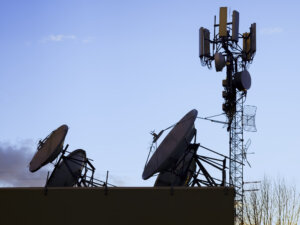
satellite dishes and relay installations on a pole against the background of an evening blue sky
Certain brands dominate market interest due to their robust networks, proven devices and ecosystem of accessories. These brands consistently appear among the most sought after for satellite phones, modems, accessories and service plans.
Iridium
Iridium is known for its truly global coverage, enabled by a constellation of LEO satellites. Its network supports voice, short burst data (SBD), tracking and broadband extensions.
Key products and categories:
- Iridium 9505A, 9555 and 9575 – popular satellite phone models used by travellers, maritime crews and field teams.
- Iridium SBD modems – specialised modems for low-data messaging, machine-to-machine (M2M) connectivity and tracking solutions.
- Antennas and batteries – rugged components for extended deployments.
- Docking systems – vehicle or vessel mounts to power and integrate Iridium phones and modems into operations.
Why Iridium is widely searched:
Iridium’s global footprint (pole-to-pole coverage) makes it a go-to for users who demand connectivity anywhere on the planet. Its devices are known for reliability in extreme conditions and compatibility with tracking and emergency systems.
Inmarsat
Inmarsat’s GEO network is synonymous with stable, wide-area satellite communication across oceans and continents. It supports broadband internet, voice and IoT services.
Key products and categories:
- IsatPhone – rugged satellite phones with strong voice and messaging performance.
- FleetBroadband – maritime broadband terminals used on ships and offshore rigs.
- Prepaid SIMs – flexible service options for voice and data usage.
- Terminals and accessories – including antennas, power systems and mounts.
Why Inmarsat is widely searched:
Inmarsat’s longstanding maritime reputation and reliability for voice and broadband make it a popular choice among shipping, logistics and enterprise sectors. Its prepaid and contract SIM options cater to diverse use cases.
Globalstar
Globalstar operates a LEO network focused on voice and data messaging, regional coverage and messaging devices.
Key products and categories:
- Handsets – satellite phones with straightforward voice and text messaging.
- Messengers – specialised messaging devices for check-in and basic data transmission.
- Regional satellite services – strong performance in select hemispheric zones.
Why Globalstar is widely searched:
Globalstar’s approachable devices and service plans appeal to users looking for reliable satellite messaging and voice in supported regions. Its portable messengers are also popular among adventure travellers and field workers.
How to Choose Between Networks and Devices
Selecting the right satellite network and hardware depends on your needs. Consider the following:
Coverage Needs
- Global missions or polar travel: Choose networks with full global LEO coverage (e.g. Iridium).
- Maritime and fixed offshore operations: GEO networks like Inmarsat often provide stable broadband and voice in maritime bands.
Data vs Voice Priorities
- Primarily voice/SOS: Satellite phones from all three brands serve this well.
- Data and messaging: Modems and SBD devices from Iridium or broadband terminals from Inmarsat deliver more capability.
Budget and Usage
- Occasional use or trips: Prepaid SIMs and portable phones help manage cost.
- Enterprise deployment: Contract plans with broadband and tracking may provide better value over time.
Accessories and Integration
- Remote vehicle operations: Docking stations, rugged antennas and extended batteries are essential.
- Tracking/IoT: Choose devices with SBD or specialised modem support.
Practical Considerations for Users
Power & Battery Life
Satellite devices must often operate far from power sources. Look for extended-life batteries and external power integration for long missions.
Durability & Environment
Devices should be rugged, weather-resistant, and capable of functioning in high vibration (vehicles/boats) or extreme temperatures.
Compliance & Licensing
Satellite services require regulatory compliance, and plans differ by region. Verify service availability and licensing requirements before deployment.
Plan Selection
Prepaid plans offer flexibility for infrequent use, while postpaid or enterprise plans suit continuous operational needs.
Summary
Satellite communication remains a cornerstone technology for connectivity where terrestrial networks do not reach. From voice-centric satellite phones to broadband modems and IoT messaging solutions, the choices span multiple networks and device types.
The brands that dominate search demand and user interest reflect practical performance and market adoption:
- Iridium – global LEO coverage with phones, SBD modems and accessory ecosystems.
- Inmarsat – GEO-based solutions with robust voice, broadband and terminal options.
- Globalstar – accessible phones and messaging devices with regional strengths.
Choosing the right satellite network and equipment requires balancing coverage, data needs, device ruggedness and budget. Whether you’re preparing for offshore work, remote exploration or emergency preparedness, understanding these networks and devices ensures you stay connected when it matters most.